
The year 2026 marks a definitive turning point in the global journey toward sustainable heating. Once considered a niche alternative for the environmentally “extreme,” heat pumps have officially matured into a scalable, high-performance technology at the heart of the “Age of Electricity.” Driven by robust real-world data and a shift in public sentiment, the narrative has moved from “Do they work?” to “How quickly can we install them?”
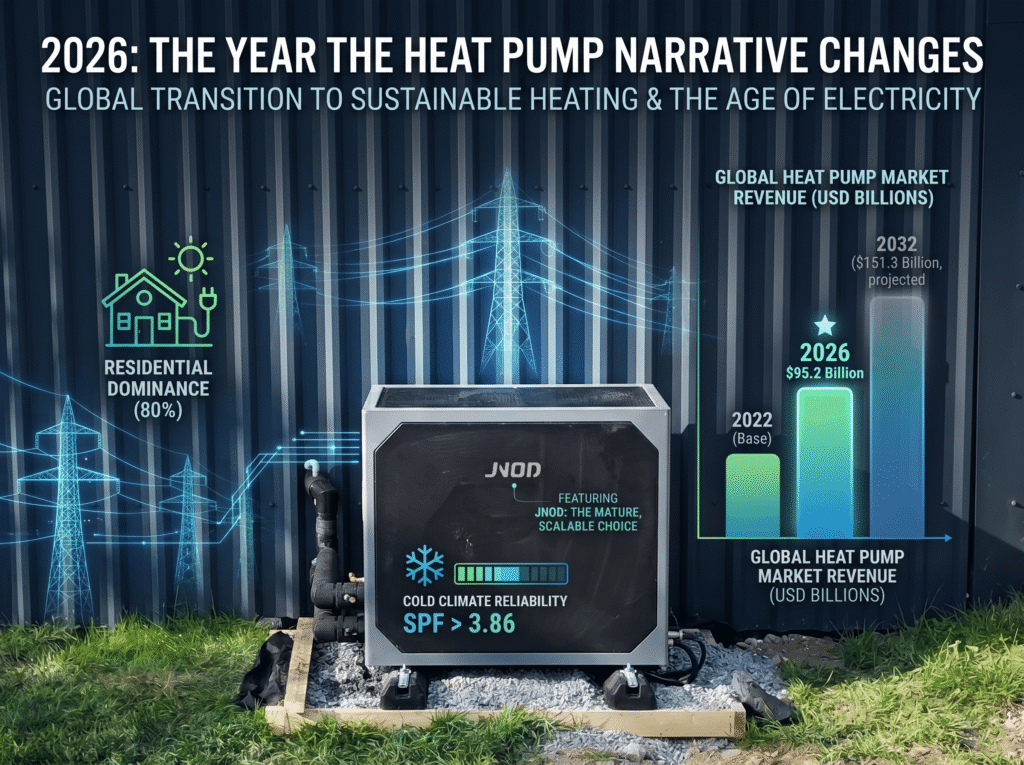
The global heat pump market is no longer a speculative venture; it is an economic powerhouse. Revenues are projected to reach USD 95.2 billion in 2026, with a steady CAGR of 8.80% signaling a trajectory toward USD 151.3 billion by 2032.
By 2035, heat pumps are expected to be the dominant heating technology across all advanced economies.
For years, the loudest argument against heat pumps was their perceived failure in freezing temperatures. In 2026, that myth has been officially dismantled.
Recent data from HeatPumpMonitor.org reveals that well-designed air-source heat pumps (ASHPs) achieve an average Seasonal Performance Factor (SPF) of 3.86—a staggering 40% improvement over older models. Furthermore, consumer satisfaction among heat pump owners during “Arctic blasts” stands at 85%, actually surpassing the 80% satisfaction rate of gas boiler users.
Countries like Norway have long proven that heat pumps are the gold standard for Arctic reliability, provided the technology is right.
The transition to sustainable heating is also a transition in chemistry. As the industry moves away from high-GWP (Global Warming Potential) synthetic refrigerants, natural alternatives like R290 and R744 are taking center stage.
Innovators like JNOD have been instrumental in this shift. Their latest R290 Full DC Inverter models are a prime example of how the industry is meeting these new standards:
| Technology | Energy Efficiency |
| High-Efficiency Gas Boiler | ~90% |
| Modern Heat Pump (e.g., JNOD A+++) | >400% (SCOP 4.0+) |
As 2026 sees record-breaking summer heatwaves of 40°C becoming common, the “heat” pump has evolved into a “comfort” pump. Polyvalent systems provide year-round climate control by seamlessly switching between heating, cooling, and domestic hot water.
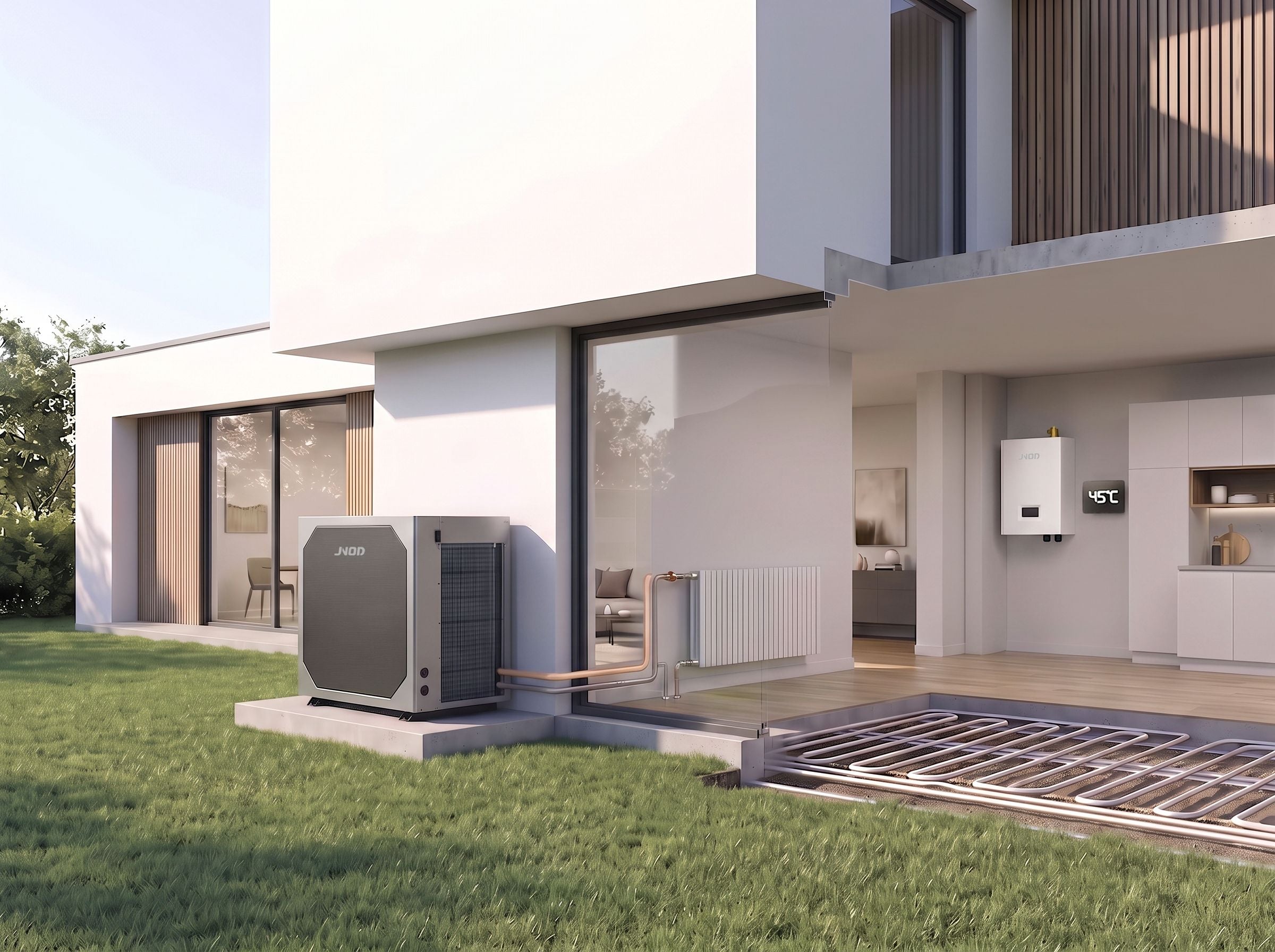
Designs have also become more “neighbor-friendly.” For instance, JNOD’s Top-Blow Monoblock heat pump have reduced noise levels to as low as 50dB, allowing for flexible installation in dense urban areas or under windows without disturbing the peace.
Despite the technological triumphs, hurdles remain. The International Energy Agency (IEA) notes that policy design is now the primary limiting factor for deployment. High upfront capital costs—ranging from £8,000 to £15,000 in the UK—continue to deter some homeowners despite significantly lower operational costs.
Strategic risks also loom in the supply chain; 90% of rotary compressor production is currently concentrated in China. To ensure long-term stability, the industry must focus on:
The narrative of 2026 is clear: the heat pump is no longer the “technology of tomorrow”—it is the indispensable tool of today. With carbon emission reductions of up to 92% over 15 years compared to gas furnaces, the environmental math is undeniable.
As companies like JNOD continue to push the boundaries of what is possible with Smart Grid-ready and PV-integrated systems, the transition to a cleaner, more efficient “Age of Electricity” is not just a goal—it is our new reality. For the narrative to stay changed, the focus must now shift to stable policy and the continued scaling of these life-changing technologies.

 English
  German
  French
  Spanish
  Italian
  Dutch
Dutch