
Quick Answer: The updated EU Heat Pump Regulations 2026 under EPBD rules and F-gas quota cuts accelerate Europe’s shift away from fossil fuels and synthetic refrigerants. Adopting natural refrigerants like R290 propane allows contractors and OEMs to deliver high flow temperatures, ensuring retrofits stay fully compliant.
Navigating Europe’s New Heating Reality
Navigating the EU Heat Pump Regulations 2026 under the transposed EPBD and proposed PFAS restrictions creates an immediate technical challenge for European heating installations. Standalone fossil fuel boilers continue losing state subsidies across EU member states. At the same time, synthetic F-gas supply quotas continue to tighten rapidly. At JNOD, our engineering team regularly meets with European installers navigating these regulatory shifts. The primary challenge remains consistent: replacing high-temperature fossil boilers in older building stock without forcing property owners into invasive, costly structural renovations.
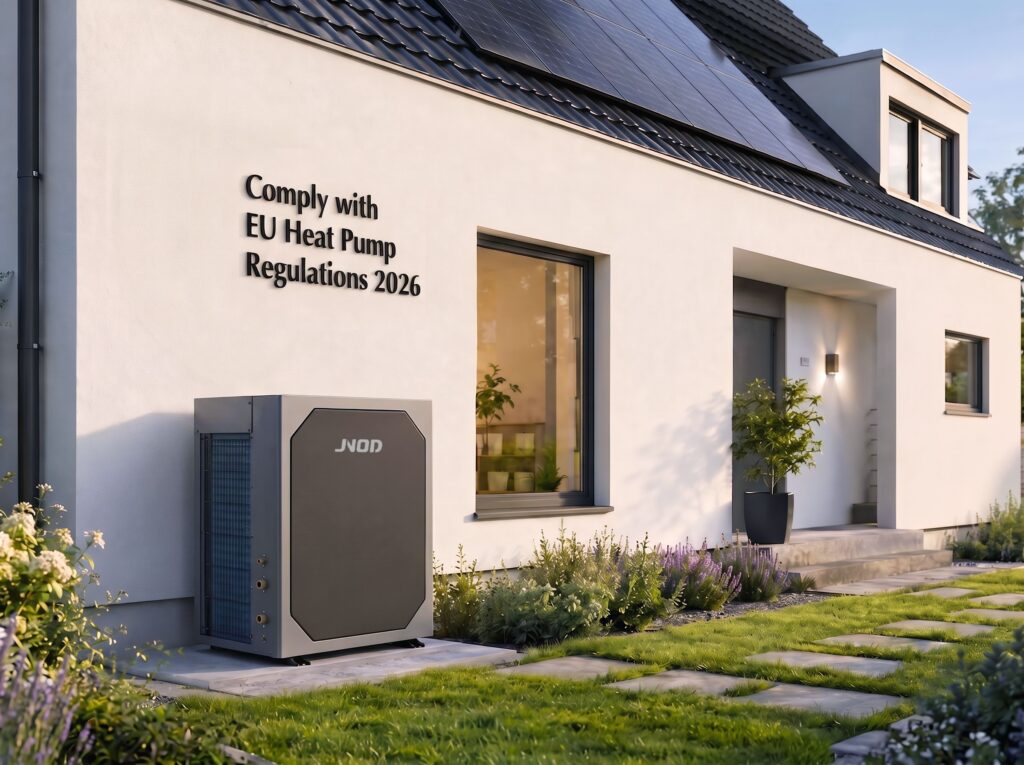
EU Heat Pump Regulations 2026: EPBD Meets PFAS
European HVAC contractors face two legislative timelines at once. Understanding these laws is essential for specifying future-proof equipment under the EU Heat Pump Regulations 2026.
1. EPBD Enforcement Across Member States
The revised European Commission EPBD directive framework sets clear decarbonization milestones. Member states must transpose national laws by May 2026 and outline full phase-outs of fossil-fuel heating by 2040. Government incentive programs now heavily favor zero-emission heat pump technology over legacy combustion systems.
2. The Universal PFAS Restriction
Chemicals classified as per- and polyfluoroalkyl substances face severe restrictions under European REACH proposals. Popular synthetic refrigerants like R134a and R410A are being phased down quickly. Even transitional solutions like R32 face potential long-term liability, rising quota costs, and strict containment limits.
Technical Design: Why R290 Propane Leads the Transition
Natural refrigerants are no longer an optional alternative. They provide the clearest path to long-term regulatory compliance.
R290 propane carries a Global Warming Potential (GWP) of just 0.02 and is completely free of PFAS chemicals. This grants installers total immunity from changing EU chemical bans.
Deploying R290 requires rigorous safety design due to its A3 flammability rating. At JNOD, our engineers isolate the entire refrigerant circuit within an outdoor monobloc housing. We incorporate dual spark-proof pressure switches, ATEX-rated fan motors, and an active safety venting system.
According to safety protocols published in IEC 60335-2-40 standards on flammable refrigerants, factory-sealed outdoor monobloc architectures completely keep flammable gases outside living spaces.
Achieving high supply water temperatures is another critical requirement for older European homes equipped with cast-iron radiators. Standard heat pumps struggle when water demand exceeds 55°C. JNOD’s R290 Monoblock SkyHeat DC Inverter Heat Pump series utilizes full-DC inverter compressors paired with Enhanced Vapor Injection (EVI) technology. This system delivers 75°C flow temperatures reliably, even when outdoor ambient conditions drop to -25°C.
Technical Comparison: Refrigerants Under EU 2026 Rules
| Feature / Metric | R410A (Legacy) | R32 (Transitional) | R290 Propane (JNOD Standard) |
|---|---|---|---|
| Global Warming Potential (GWP) | 2088 | 675 | 0.02 |
| PFAS Chemical Risk | High Risk | Moderate Risk | Zero (PFAS-Free) |
| Max Water Supply Temperature | 55°C | 60°C | 75°C |
| Retrofit Radiator Compatibility | Poor | Moderate | Excellent |
| F-Gas Quota Exposure | High Cost / Phasing Out | Escalating Costs | 100% Exempt |
Overcoming Retrofit Obstacles in European Properties
Updating older residential structures often introduces tight acoustic and electrical constraints.
Low-Noise Acoustic Engineering
European municipal codes strictly limit night-time sound output, often requiring levels under 35 dB(A) at property lines. JNOD addresses this by pairing step-less DC inverter fans with an encapsulated compressor housing and oversized evaporator coils.
Smart Grid Integration (SG-Ready)
Our onboard controllers feature native Smart Grid contacts. The system automatically shifts power consumption to pre-heat domestic water buffers when connected solar PV systems generate excess energy.
Conclusion: Future-Proofing European Projects
The regulatory landscape across Europe is shifting permanently. Waiting to transition away from F-gases creates supply risks and compliance delays. JNOD builds high-efficiency R290 monobloc heat pumps to simplify retrofits, meet strict acoustic standards, and help contractors deliver future-proof installations.
Frequently Asked Questions
What is the EPBD deadline for phasing out fossil fuel boilers?
The EPBD framework requires member states to establish phase-out strategies for fossil fuel heating by 2040 at the latest. However, financial subsidies for standalone fossil boilers are already being eliminated across many EU countries.
Why are natural refrigerants preferred over R32 under upcoming EU laws?
R32 remains subject to escalating quota restrictions and cost increases under the revised F-gas Regulation. R290 propane is a natural refrigerant with a GWP of 0.02 and zero PFAS content, making it fully exempt from future chemical bans and quotas.
Can an R290 heat pump replace a boiler without changing existing radiators?
Yes. High-temperature R290 monobloc heat pumps reach water supply temperatures up to 75°C. This output allows them to operate existing radiator circuits efficiently without needing underfloor heating retrofits.
OEM Support and Technical Specifications
Ensure your upcoming projects meet all European energy performance and safety directives. Discover how the JNOD R290 SkyHeat DC Inverter Heat Pump delivers quiet, ultra-efficient performance for European retrofits.
Contact JNOD’s Engineering Team Today to request technical schematics, acoustic test reports, or OEM partnership details.
 English
  German
  French
  Spanish
  Italian
  Dutch
Dutch