
Choosing between a hydraulic module vs. wiring center can make or break your installation speed. Labor costs in Europe and North America are skyrocketing. When you arrive at a job site to install an air-to-water heat pump, every extra hour of pipe welding or electrical troubleshooting cuts right into your profit margin. Let’s look at which solution fits your project best.
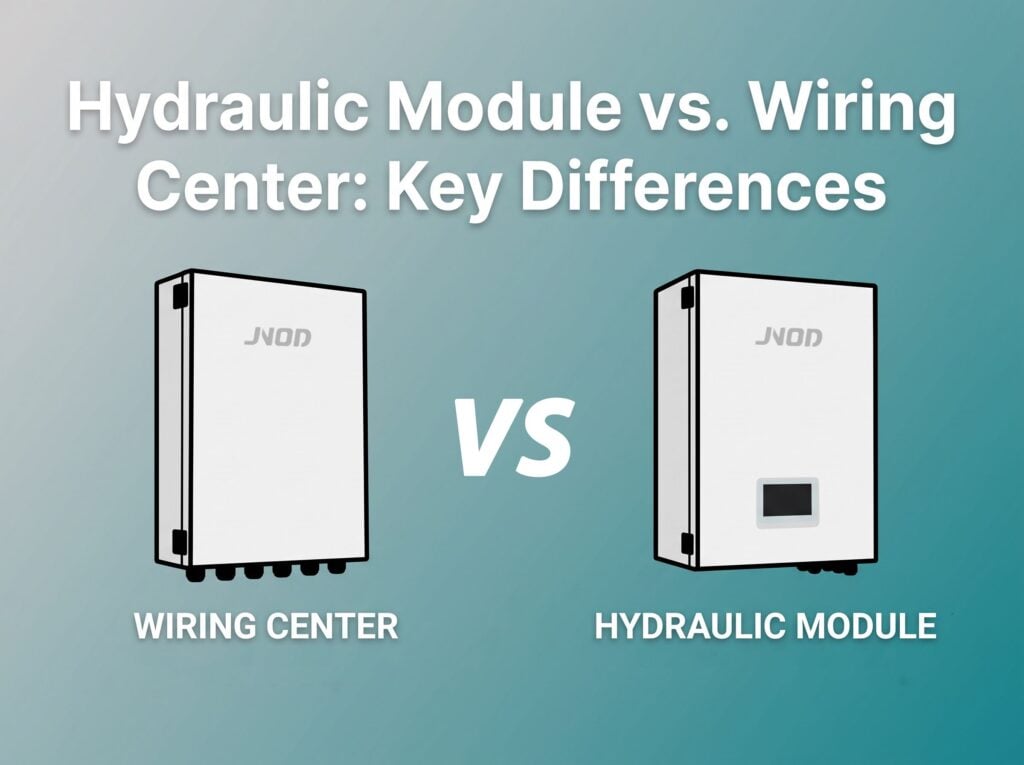
A hydraulic module manages the water side—integrating the circulating pump, expansion vessel, 3-way valve, and backup heater into one compact indoor casing to eliminate piping chaos. A wiring center handles the electrical and control side—providing pre-labeled terminal blocks, relay switches, and smart communication to link your heat pump with thermostats and zone valves without a mess of loose cables.
Plumbing a heat pump system from scratch on-site is slow and prone to leaks. You have to mount an expansion vessel on the wall, solder copper pipes, wire a separate 3-way diverter valve, and bleed the system manually.
A hydraulic module solves this by moving all of that labor into a factory-tested enclosure. At JNOD, we designed our heat pump hydraulic module with a 5L expansion tank specifically for contractors who want a clean, plug-and-play installation. Inside the insulated box, you get a high-efficiency variable-speed circulation pump, an expansion vessel, safety relief valves, an electric auxiliary heater, and a pressure gauge.
Everything comes pre-piped and pre-leak-tested. You just connect the flow and return pipes from the monobloc outdoor unit, hook up the domestic hot water (DHW) cylinder and space heating loops, and you are ready to flush the circuit. It saves up to 4–6 hours of plumbing labor on every single house!
Modern heating systems are complex. You often have multiple room thermostats, underfloor mixing valves, fan coils, booster heaters, and grid signals like SG Ready. Wiring them directly into a tight outdoor unit terminal board in freezing weather is pure frustration.
A wiring center acts as the central brain and routing station for your low-voltage and high-voltage connections. We developed our dedicated wire center box for monobloc top-blow heat pumps to give installers a neat, labeled junction area inside the utility room. It houses interlocked relays, clear color-coded terminal strips, sensor inputs, and PCB controllers in one place.
You run a single power and communication cable from the outdoor heat pump to the indoor box. All your zone valves, room stats, and cylinder sensors land directly inside this box. Troubleshooting takes minutes instead of hours because every test point is right in front of you.
| Feature | Hydraulic Module | Wiring Center |
|---|---|---|
| Primary Focus | Fluid Dynamics & Water Piping (Hydronics) | Electrical Integration & Signal Routing |
| Core Components | Water pump, expansion tank, 3-way valve, electric heater | Terminal blocks, relays, PCB, sensor ports, fuses |
| Piping Connection | 1″ or 1-1/4″ Copper / Stainless Steel Ports | None (Pure electrical and signal) |
| Main Job Site Benefit | Eliminates manual pipe welding and component sizing | Eliminates loose wiring clutter and signal crosstalk |
| Labor Time Saved | 4 to 6 hours of pipefitting & pressure testing | 2 to 3 hours of electrical wiring & debugging |
| Typical Mounting | Wall-mounted near DHW tank or buffer tank | Wall-mounted in dry utility cupboard |
Yes, absolutely! In many premium residential projects across the UK and Germany, combining a pre-plumbed hydraulic unit with an indoor wiring box gives you the ultimate setup. One handles water, the other handles power. Zero clutter, zero guesswork.
Most quality hydraulic boxes—including JNOD models—come with an integrated 3kW to 9kW electric booster heater. This ensures continuous heating during extreme winter defrost cycles or when the heat pump is disinfected for Legionella.
Yes. Quality wiring centers separate high-voltage AC power lines from sensitive low-voltage temperature sensor wires (NTC sensors). This complies with IEC International Electrical Standards and prevents false temperature readings or communication dropouts.
No, it actually protects your warranty. Pre-tested hydraulic and electrical components guarantee proper water flow rates and correct circuit protection, reducing field failures drastically.
Deciding on a hydraulic module vs. wiring center comes down to whether your biggest job site challenge is water piping or electrical wiring. JNOD provides complete, factory-matched R290 monobloc heat pumps, pre-plumbed hydraulic modules, and dedicated wiring boxes designed specifically for OEM partners and HVAC distributors.
Ready to cut your installation time in half? Contact our technical team today to request wholesale pricing, OEM customization options, and comprehensive technical datasheets.
 English
  German
  French
  Spanish
  Italian
  Dutch
Dutch