
Heat pump outdoor unit placement involves more than finding enough room for the equipment. Airflow, defrost drainage, noise and maintenance access all affect whether an installation location is suitable.
A unit may fit neatly beside a building but still encounter problems if surrounding walls restrict airflow or leave insufficient space for servicing.
A suitable location needs clear air inlets and outlets, proper drainage and enough room for maintenance. For R290 heat pumps, refrigerant safety requirements must also be considered.
This guide explains what installers should check before confirming an outdoor installation location, with practical examples from JNOD’s R290 top-blow monobloc heat pumps.
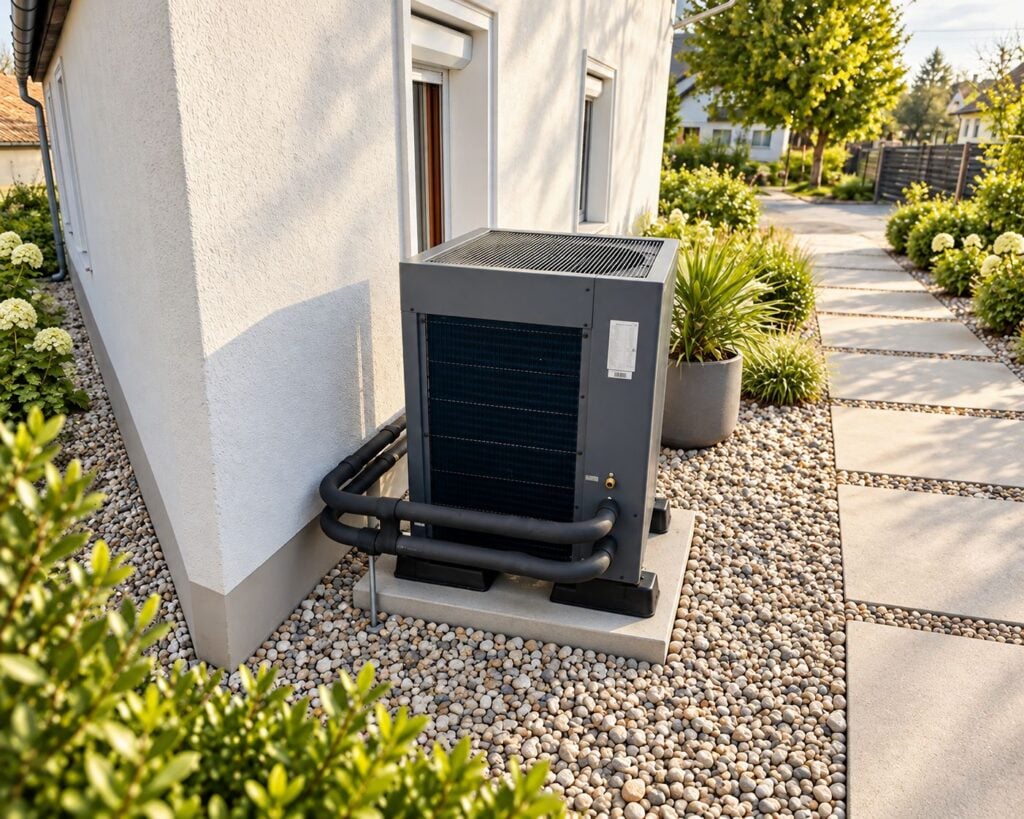
An outdoor heat pump needs a stable mounting surface, sufficient airflow and a suitable drainage arrangement.
Gardens, side passages and external service areas can all be considered, depending on the building layout and equipment requirements. Open balconies and rooftops may also be possible where structural, airflow and safety conditions permit.
The available space around the unit matters just as much as the dimensions of the cabinet.
For example, a narrow passage between two houses may appear large enough for a compact heat pump. However, if nearby walls restrict airflow or prevent access to service panels, the location may still be unsuitable.
Before choosing the position, check the surrounding structures, airflow direction, drainage route, nearby windows and access for maintenance.
JNOD offers several configurations within its air source heat pump range, including top-blow and side-blow models for different installation conditions.
There is no universal installation distance that applies to every heat pump.
The required clearance depends on the unit’s dimensions, air inlet position, discharge direction and manufacturer’s instructions.
For side-discharge heat pumps, the area in front of the fan must allow discharged air to move away without significant obstruction.
Top-discharge heat pumps direct air upward, but they still need sufficient space around their air inlets and above the outlet.
Top discharge does not mean zero clearance.
JNOD’s installation manual for its JMU top-blow monobloc series includes a clearance diagram with the following dimensions:
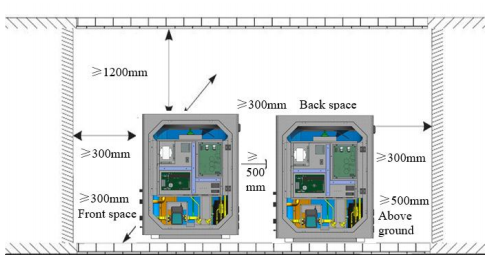
| Installation area | Clearance shown in the JNOD manual |
|---|---|
| Indicated front, rear and side clearances | ≥300 mm |
| Space between two adjacent units | ≥500 mm |
| Overhead clearance | ≥1,200 mm |
| Height above ground | ≥500 mm |
These dimensions come from the installation arrangement illustrated in the manual.
They should not be treated as universal requirements for every heat pump or as R290 refrigerant safety-zone distances.
Before installation, contractors should check the manual for the exact model and confirm that the proposed layout meets applicable safety requirements.
A top-blow heat pump draws outdoor air through its heat exchanger and discharges air upward.
If a wall or fence is too close to the air inlet, airflow may be restricted even when the top outlet is unobstructed.
Overhead structures matter as well. A balcony or low roof above the unit can interfere with vertical air discharge.
Installers should therefore evaluate the complete airflow path rather than checking only one side of the cabinet.
Narrow installation areas are common in residential projects, particularly between terraced houses or along building side passages.
The challenge is not simply fitting the heat pump into the available width.
During heating operation, an air source heat pump extracts heat from outdoor air and discharges cooler air.
If that discharged air repeatedly returns to the air inlet, the unit may operate under less favorable conditions.
This is known as air recirculation.
The effect depends on the airflow design, surrounding walls, wind conditions and available open space.
A top-blow design directs discharged air upward rather than horizontally toward a nearby wall or walkway.
This can offer installation advantages in locations where horizontal discharge is difficult to accommodate.
JNOD’s small-space heat pump solution includes R290 top-blow models intended for applications such as compact gardens and narrow residential spaces.
However, upward discharge alone does not guarantee suitable airflow.
The installer still needs to consider side air inlets, overhead clearance, surrounding walls and local conditions.
For a more detailed comparison of the two configurations, see JNOD’s article on side-discharge and top-discharge heat pumps.
Drainage is often overlooked in heat pump outdoor unit placement, especially when installation takes place during warm weather.
During heating operation, moisture can freeze on the outdoor heat exchanger. When the unit enters a defrost cycle, the frost melts and water is released.
If water collects beneath the equipment, it may freeze again as outdoor temperatures fall.
Ice accumulation can obstruct drainage or create slippery surfaces near the installation.
ENERGY STAR’s outdoor heat pump installation guidance also highlights unobstructed airflow, defrost-water icing, roof runoff and maintenance access.
Although that guidance focuses on ductless heat pumps, these general site-planning considerations are relevant to outdoor air source heat pumps.
For installations exposed to snow, freezing temperatures or severe winter conditions, JNOD’s installation manual recommends raising the outdoor unit approximately 500 mm above ground level.
This provides additional clearance beneath the equipment and helps reduce the risk of snow obstructing the unit.
The manual also requires an appropriate drainage arrangement for condensate released during defrosting.
However, raising the unit does not eliminate the need for a suitable drainage route.
Installers should check whether water can collect beneath the cabinet, freeze near a walkway or flow toward the building foundation.
The installation manual also discusses protective overhead covering in severe weather. For top-discharge equipment, any proposed cover must be assessed carefully to ensure that it does not obstruct vertical airflow or compromise the required clearances.
For R290 systems, drainage planning also needs to consider refrigerant safety.
R290 is propane. In the event of a leak, it may accumulate in low-lying or poorly ventilated areas.
A drainage arrangement must not create an unsafe path for leaked refrigerant to enter enclosed spaces, underground channels or other potential accumulation areas.
Contractors should follow the equipment’s specific drainage and refrigerant safety-zone requirements.
R290 has a very low global warming potential, making it an important refrigerant for modern heat pump development.
However, R290 is classified as an A3 refrigerant, which means its flammability must be addressed through suitable equipment design, installation and maintenance procedures.
For R290 models, heat pump outdoor unit placement must also account for nearby openings and areas where leaked refrigerant could accumulate.
These may include basement windows, ventilation openings, underground pits, trenches and drains.
The exact restrictions depend on the refrigerant charge, equipment design, applicable standards and local regulations.
The European SKILLSAFE EU project provides a guideline on the safe handling of R290 monobloc heat pumps, covering installation, commissioning, maintenance and other aspects of working with these systems.
No.
A top-blow heat pump directs operating airflow upward, but this does not mean leaked refrigerant will always disperse upward.
A leak may occur when the fan is not operating. Under certain conditions, propane can move into low-lying areas.
Therefore, vertical air discharge must not be treated as a substitute for refrigerant safety measures.
JNOD’s R290 Monoblock Top-Blow SkyHeat heat pump offers a compact top-discharge configuration, but its installation must still comply with the applicable clearance and refrigerant safety requirements.
A suitable installation location should also consider noise and vibration.
Outdoor heat pumps produce sound from the compressor, fan and other operating components.
The perceived noise depends not only on the manufacturer’s sound rating but also on surrounding walls, nearby windows and the distance to occupied areas.
JNOD’s installation manual advises avoiding locations close to bedrooms or living rooms because of operating noise.
For residential installations, the position should therefore be evaluated in relation to neighboring properties, bedroom windows and outdoor living spaces.
The outdoor unit should be installed on suitable concrete supports or a dedicated mounting bracket.
JNOD’s installation manual specifies that the mounting bracket must be capable of supporting at least five times the unit’s weight.
For example, the JMU90HC has a published net weight of 116 kg and dimensions of 700 × 675 × 910 mm.
This means the mounting structure must be selected and verified for the actual equipment and installation conditions, rather than simply matching the cabinet dimensions.
The support should be securely fixed, with appropriate consideration given to vibration, structural loading and environmental conditions.
JNOD’s installation manual also advises keeping the outdoor unit away from kitchen exhaust outlets.
Oil and grease carried in exhaust air can accumulate on the heat exchanger, making cleaning more difficult and potentially affecting heat transfer.
The unit should also remain accessible for servicing.
Technicians may need to remove panels, inspect electrical components, clean the heat exchanger or access water connections.
A location that provides enough room for installation but not maintenance should be reconsidered.
Consider a terraced-house project with a narrow outdoor passage and a boundary wall along one side.
The available width may be sufficient for a compact top-blow heat pump, but that does not automatically confirm the installation is suitable.
An installer should first check the equipment dimensions and the required airflow clearances.
For example, JNOD’s JMU90HC cabinet measures 700 × 675 × 910 mm. The space required for installation is greater than the equipment footprint because additional room is needed for airflow, drainage and maintenance.
The installer should also check whether vertical discharge is unobstructed and whether nearby walls affect the air inlets.
Winter drainage needs attention, particularly if the passage is used as a walkway.
If the unit uses R290, nearby basement openings, drains and potential gas accumulation areas must also be assessed.
Noise and vibration may require closer consideration because the heat pump is located between two buildings.
If one of these conditions cannot be satisfied, the installation layout or selected equipment may need to change.
This example is illustrative rather than a completed JNOD project. It shows why compact equipment dimensions and installation suitability are not the same thing.
Before confirming the installation location, installers should review the following items.
| Site condition | What to check |
|---|---|
| Airflow | Air inlets and discharge paths remain unobstructed |
| Clearance | Model-specific installation distances are satisfied |
| Overhead space | Roofs, balconies and covers do not restrict discharge |
| Drainage | Condensate and defrost water can leave the area safely |
| Winter conditions | Snow and ice cannot obstruct the unit |
| R290 safety | Relevant openings and potential gas accumulation areas are assessed |
| Noise | Nearby occupied spaces and neighboring properties are considered |
| Mounting | The support structure meets the equipment requirements |
| Maintenance | Service panels and connections remain accessible |
This checklist supports site planning but does not replace the manufacturer’s installation manual.
Once the installation location is confirmed, the remaining work should follow the requirements for the selected system.
For general procedures, see JNOD’s heat pump installation guide.
Yes, provided the installation meets the manufacturer’s airflow, maintenance and refrigerant safety requirements. The required clearance depends on the model and surrounding conditions.
JNOD’s July 2026 installation manual illustrates clearances including 300 mm in specified surrounding positions, 500 mm between adjacent units and 1,200 mm overhead. The exact model and site requirements must be checked before installation.
It depends on the equipment and climate. For harsh winter conditions, JNOD’s manual recommends approximately 500 mm of ground clearance. Snow accumulation, drainage and structural requirements should also be considered.
Only if the manufacturer’s overhead clearance, airflow and safety requirements can be met. An overhead obstruction may interfere with vertical discharge.
Yes. During heating operation, condensate and melted frost can produce water around the outdoor unit. The installation should provide an appropriate drainage route, especially in freezing conditions.
The installation must comply with the manufacturer’s refrigerant safety-zone requirements and applicable regulations. Low-level openings require particular attention because propane may accumulate in poorly ventilated areas.
A suitable heat pump outdoor unit location must provide more than enough physical space for the equipment.
Airflow, drainage, mounting conditions, maintenance access, noise and refrigerant safety all influence whether the installation will perform as intended.
Top-blow heat pumps can provide useful installation flexibility in narrow residential spaces where horizontal air discharge is difficult to accommodate.
However, the final decision still depends on the equipment, surrounding structures and model-specific installation requirements.
For distributors and HVAC contractors, heat pump outdoor unit placement should be reviewed against the site dimensions, surrounding structures, drainage conditions and model-specific installation requirements before equipment selection is finalized.
 English
  German
  French
  Spanish
  Italian
  Dutch
Dutch