
Heat pump performance data can tell you much more than the nominal capacity shown on a product nameplate. A heat pump rated at 9 kW does not necessarily deliver 9 kW when the outdoor temperature falls to -15°C.
This is why heat pump performance data matters when selecting a unit for a cold-climate project. The capacity shown in a product name or basic brochure is normally based on a specific test condition. Change the outdoor temperature or the required water temperature, and the result can change.
For installers, distributors, and project buyers, the useful question is simple: how much heat can the unit deliver under the conditions of the project?
Using Heat Pump Performance Data for Cold-Climate Selection
When reviewing a performance table, check the outdoor temperature first.
A unit may be rated at 9 kW under a mild test condition, but a building normally needs more heating when the weather is coldest. For equipment selection, the more useful figure is therefore the capacity available at the project’s design outdoor temperature.
JNOD’s JMU90HC is a good example. It is a 9 kW R290 monobloc top-blow heat pump, but its published capacity changes as outdoor temperature falls.
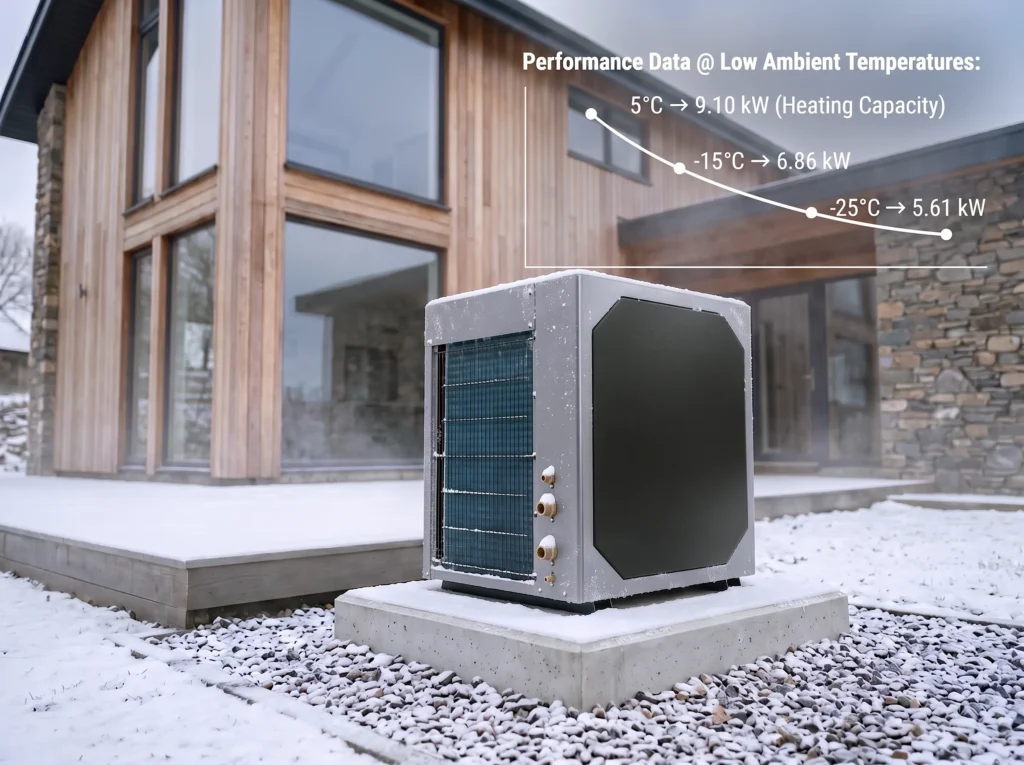
At 35°C outlet water, the published heating capacity is:
| Outdoor temperature | Heating capacity |
|---|---|
| 5°C | 9.10 kW |
| -15°C | 6.86 kW |
| -25°C | 5.61 kW |
The model name stays the same. The available heating output does not.
So when a product is described as a “9 kW heat pump”, the next question should be:
9 kW at what outdoor temperature and what water temperature?
For cold-climate sizing, PNNL recommends using extended manufacturer performance data and comparing the available capacity with the building’s design heating load rather than relying only on nameplate capacity. See PNNL’s cold-climate heat pump sizing guidance.
Check the Water Temperature
Outdoor temperature is only part of the picture.
A heat pump supplying 35°C water is working under a different condition from the same unit supplying 55°C water. That difference matters for systems using underfloor heating, radiators, or mixed emitters.
The JMU90HC data shows this clearly. At -15°C outdoor temperature, its published heating capacity changes to:
| Outlet-water temperature | Heating capacity |
|---|---|
| 35°C | 6.86 kW |
| 45°C | 5.73 kW |
| 55°C | 5.41 kW |
At -25°C, the published capacity is 5.61 kW at 35°C water, 4.45 kW at 45°C, and 3.91 kW at 55°C.
This matters when comparing equipment. A project that needs 55°C water cannot use the 35°C performance figure simply because it is higher.
The relationship between leaving-water temperature and system performance is covered in more detail in JNOD’s heat pump flow temperature guide for installers.
COP Is Only Useful With Its Test Conditions
COP is often the number buyers notice first, but it is easy to compare it incorrectly.
The calculation is simple:
COP = Heating output ÷ Electrical power input
The important part is the condition behind the number.
For the JMU90HC, the published COP at 35°C outlet water is:
| Outdoor temperature | COP |
|---|---|
| 5°C | 4.70 |
| -15°C | 2.33 |
| -25°C | 1.72 |
At 55°C outlet water, COP changes from 3.10 at 5°C to 1.66 at -15°C and 1.18 at -25°C.
So if two heat pumps show different COP values, check the test conditions before comparing them.
Use the same: Outdoor temperature + outlet-water temperature + test condition
for both products. A COP measured at 7°C outdoor temperature and 35°C water should not be compared directly with a COP measured at -15°C and 55°C water.
For more operating data, see the JNOD JMU90HC R290 top-blow heat pump.
Check the Design Temperature Before Choosing the Model
A building does not stay at its design outdoor temperature all winter.
The design temperature is the condition used to determine how much heating the building needs during colder weather. It varies by location and design method.
That gives installers a practical way to use a performance table.
Imagine a project with a calculated heating load of 6 kW at -15°C. A 9 kW heat pump may look large enough. The next step is to check its published capacity at: -15°C outdoor temperature and at the water temperature required by the heating system.
For the JMU90HC, the published capacity at -15°C is 6.86 kW with 35°C outlet water, but 5.41 kW with 55°C outlet water.
That difference can change the equipment decision.
PNNL recommends this type of comparison for cold-climate heat pump selection: match the manufacturer’s extended performance data with the building’s design heating load.
Do Not Confuse the Operating Limit With Heating Capacity
This specification is easy to misunderstand.
If a heat pump is listed as operating down to -25°C, that tells you the specified operating limit. It does not mean the unit will produce its nominal rated capacity at -25°C.
The JMU90HC illustrates the difference. Its published performance extends to -25°C, but the available heating capacity at that temperature is lower than at 5°C.
So when you see:
Operating range: down to -25°C
look for the capacity table as well.
The operating range tells you whether the unit can operate under that condition. The performance table tells you what output is available.
JNOD’s cold climate heat pump solutions are intended for projects where low outdoor temperatures are an important part of product selection.
Minimum Capacity Matters Too
Cold-climate selection is not only about the coldest day.
Most of the heating season is normally spent above the design outdoor temperature. An inverter heat pump therefore needs to reduce its output as the building load falls.
This is where minimum capacity becomes useful.
A unit that can cover the load on a very cold day may still need to operate at much lower output during milder weather. If the minimum capacity is too high for the application, cycling can become a concern.
This is why PNNL also recommends considering both maximum and minimum heating capacity when selecting variable-capacity heat pumps.
For an installer, it is worth checking both sides:
Can the unit cover the peak load?
Can it turn down enough when the building needs less heat?
How to Read a Performance Table for a Real Project
A simple way to work with a performance table is to start with one actual design condition.
For example:
Design outdoor temperature: -15°C
Required outlet-water temperature: 45°C
Building heating load: 6 kW
Now check the selected model at those conditions.
For the JMU90HC, the published heating capacity at -15°C and 45°C outlet water is 5.73 kW, with a COP of 1.95.
That immediately shows that the model does not provide the same output at -15°C as it does at its nominal rating condition.
From there, the installer can look at the rest of the system:
- Can the required water temperature be reduced?
- Are the heating emitters correctly sized?
- Is another model more suitable?
- Is auxiliary heating needed?
- Does the selected unit have enough modulation range?
The performance table gives the numbers needed for that assessment.
What Happens During Defrost?
In cold and humid weather, frost can build up on the outdoor heat exchanger.
The heat pump then needs to run a defrost cycle to remove the frost. During defrost, the unit is not operating in the same way as it does during normal heating, so short-term heat output and power consumption can change.
This is one reason to avoid treating one low-temperature data point as a constant output for the entire winter.
For a cold-climate project, it is worth asking the manufacturer about defrost control as well as published capacity and COP.
The wider system design also matters. Flow temperature, heating emitters, controls, and electrical supply all need to work with the selected heat pump.
For projects where the outdoor unit has limited installation space, JNOD also offers small-space heat pump solutions using top-blow air discharge.
What Should You Ask the Manufacturer?
When comparing heat pumps for a cold-climate project, ask for heat pump performance data that matches the job.
At minimum, request:
| Information | Why it matters |
|---|---|
| Heating capacity at design temperature | Shows whether the unit can cover the load |
| COP at the same condition | Gives a realistic efficiency reference |
| Capacity at different water temperatures | Shows the effect of system requirements |
| Minimum and maximum capacity | Helps assess modulation |
| Operating temperature range | Defines the specified climate range |
| Defrost information | Useful for cold and humid conditions |
| Test conditions | Makes product comparisons meaningful |
For North American buyers, ENERGY STAR’s current cold-climate criteria provide another useful reference. Qualifying equipment must meet specific low-temperature performance requirements, including COP and heating-capacity requirements at 5°F (-15°C). These are ENERGY STAR certification criteria, not universal requirements for every heat pump. See the current ENERGY STAR heat pump criteria.
How JNOD Uses Performance Data
JNOD publishes extended performance data for selected R290 air source heat pumps.
The JMU90HC performance table covers outdoor temperatures from -25°C to 25°C and provides heating capacity, power input, and COP at different outlet-water temperatures.
That gives installers and project buyers a better basis for comparison than a single rated capacity.
For a wider view of JNOD’s product range, see the air source heat pump range.
The same principle applies to any manufacturer: use the performance table under conditions close to those of the project rather than relying on the model name alone.
FAQ
In many air source heat pumps, heating capacity decreases as outdoor temperature falls. The amount of change depends on the model and the operating conditions.
No. A 9 kW rating refers to a defined test condition. Actual heating capacity can be different at lower outdoor temperatures or higher outlet-water temperatures.
Because the heat pump has to produce the required heating-water temperature as well as extract heat from outdoor air. A higher water temperature can change both heating capacity and COP.
It means the manufacturer specifies operation down to that outdoor temperature under stated conditions. It does not mean the unit will deliver its nominal rated capacity at -25°C.
Use the same outdoor temperature and outlet-water temperature when comparing heating capacity and COP. Then check minimum capacity, operating range, defrost strategy, electrical requirements, and the building’s heating load.
Final Summary
A heat pump’s nameplate capacity is only one point in a much larger performance picture.
For a cold-climate project, the numbers that matter are the ones that match the actual design:
Outdoor temperature + outlet-water temperature + heating capacity + COP + building load.
A 9 kW model may provide close to its rated output under mild test conditions and considerably less at -15°C or -25°C. The performance table shows that change.
For installers, distributors, and project buyers, the practical approach is to check what the unit can actually deliver at the conditions the project requires.
 English
  German
  French
  Spanish
  Italian
  Dutch
Dutch