
For modern residential and commercial developers, choosing between gas boilers and air source heat pumps (ASHPs) is an important decision. Cost, energy efficiency, and regulations all affect long-term project value. As global energy policies change and carbon taxes increase, Total Cost of Ownership (TCO) has become a key factor in project planning.
In the past, gas systems usually had lower upfront costs (CAPEX)). However, rising energy prices and new technologies are changing the market. Modern air source heat pump, such as the JNOD R290 skyheat series, are improving efficiency and reducing long-term operating costs. This has significantly changed the ROI comparison between heat pumps and traditional gas systems.

Project managers and wholesalers face significant hurdles today:
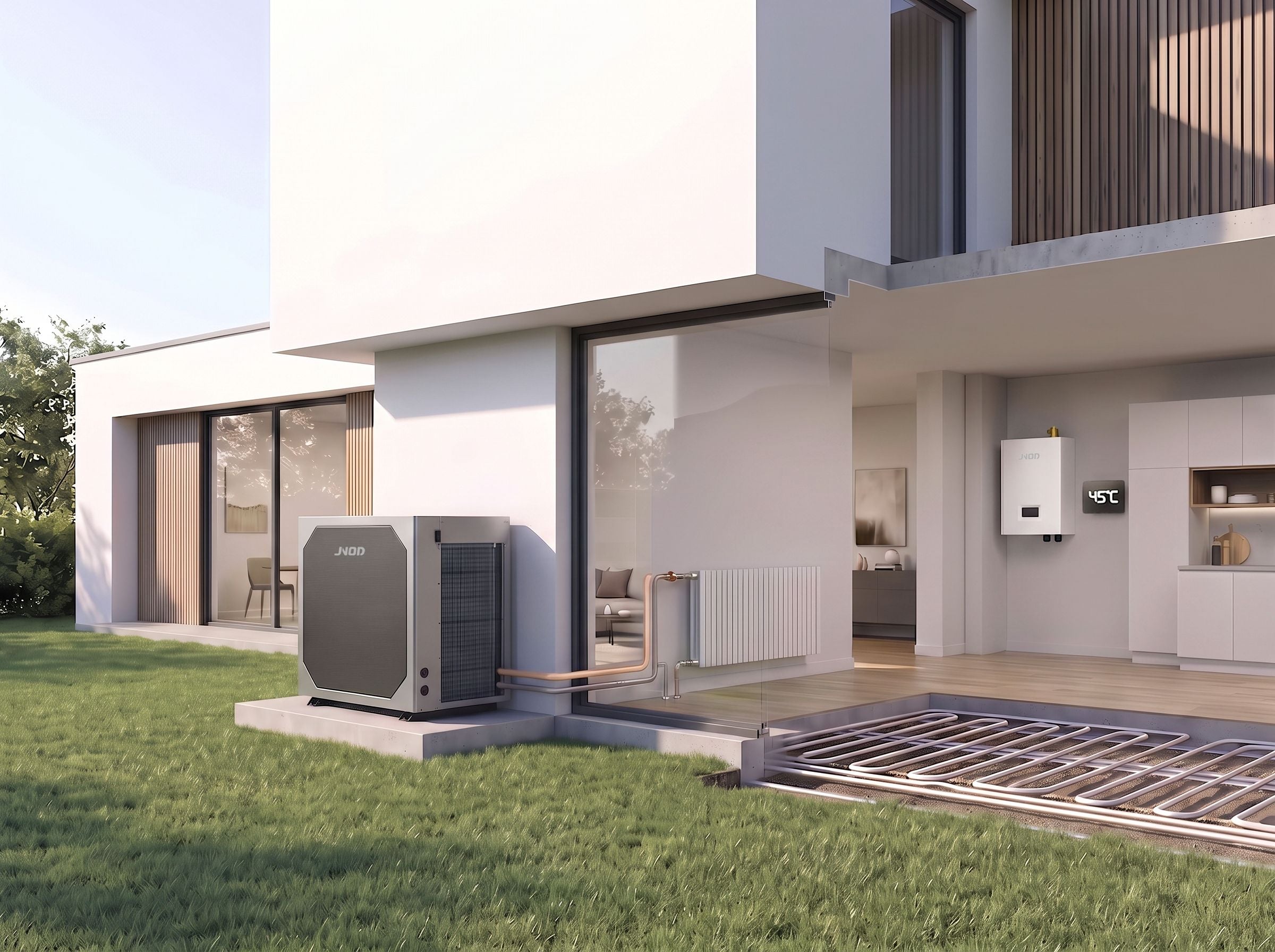
Unlike gas boilers that rely on combustion, JNOD air source heat pumps utilize a thermodynamic cycle to transfer heat from the ambient air, achieving efficiencies far exceeding 100%.
| Feature | JNOD R290 Air Source Heat Pump | Traditional Gas-Fired Boiler |
| Energy Efficiency | Up to 470% (COP 4.65–4.75) | Max 92% – 95% (Condensing) |
| Refrigerant/Fuel | R290 Propane (GWP = 3) | Natural Gas / LPG |
| Max Outlet Temp | 75°C | 80°C |
| Environmental Impact | Zero on-site CO2 emissions | Significant carbon footprint |
| Installation Logic | Monoblock & All-in-one “Plug & Play” | Complex gas piping and venting |
| Maintenance | Remote monitoring via Smart IoT | Annual safety/flue inspections |
Test data shows that JNOD units such as the JMU90HC R290 monoblock top-blow skyheat DC inverter air source heat pump, provide a coefficient of Performance (COP) of 4.65. This means for every 1 kW of electricity consumed, the system generates 4.65 kW of thermal energy. In contrast, a gas boiler can never exceed 1 kW of heat per 1 kW of fuel energy.
Labor shortages for F-Gas certified technicians are a major bottleneck for large projects. JNOD’s Monoblock Heat Pump design integrates the entire refrigerant circuit into the outdoor unit. This solution eliminates the need for on-site refrigerant piping, reducing labor hours and minimizing the risk of leaks.
The use of R290 (Propane) is a strategic advantage for Business buyers. With a Global Warming Potential (GWP) of only 3, it is exempt from the heavy taxes and phase-out schedules affecting R32 or R410A units. JNOD’s R290 units can reach outlet water temperatures of 75°C, making them suitable for both modern underfloor heating and high-temperature radiator retrofits.
All JNOD systems are equipped with Smart IoT Displays and independent app control. For property managers, this enables remote fault analysis and energy monitoring, significantly reducing the frequency and cost of on-site service calls.
The technical TCO analysis confirms that while ASHPs require a higher initial investment, the combination of energy savings, reduced maintenance, and regulatory compliance ensures a superior long-term financial outcome. JNOD, with 15 years of industry deep cultivation and an annual production capacity of 200,000 units, provides the stability and technical authority required for large-scale Business partnerships.
Q: What are the MOQ requirements for wholesale orders?
A: As a direct manufacturer, JNOD offers flexible volumes tailored to project scales. Please contact our export department for tiered pricing.
Q: What certifications do JNOD products hold for global markets?
A: Our factory adheres to ISO international quality management systems (ISO 9001, 14001, 45001). Products are certified with CE, ERP, ETL, and CB
Q: Does JNOD provide customized technical support for builders?
A: Yes. We have a dedicated R&D team of 45+ research personnel to provide customized services, including acoustic testing and transportation simulation
Ready to optimize your next development? Connect with JNOD today to receive a customized TCO projection and wholesale catalog.
 English
  German
  French
  Spanish
  Italian
  Dutch
Dutch